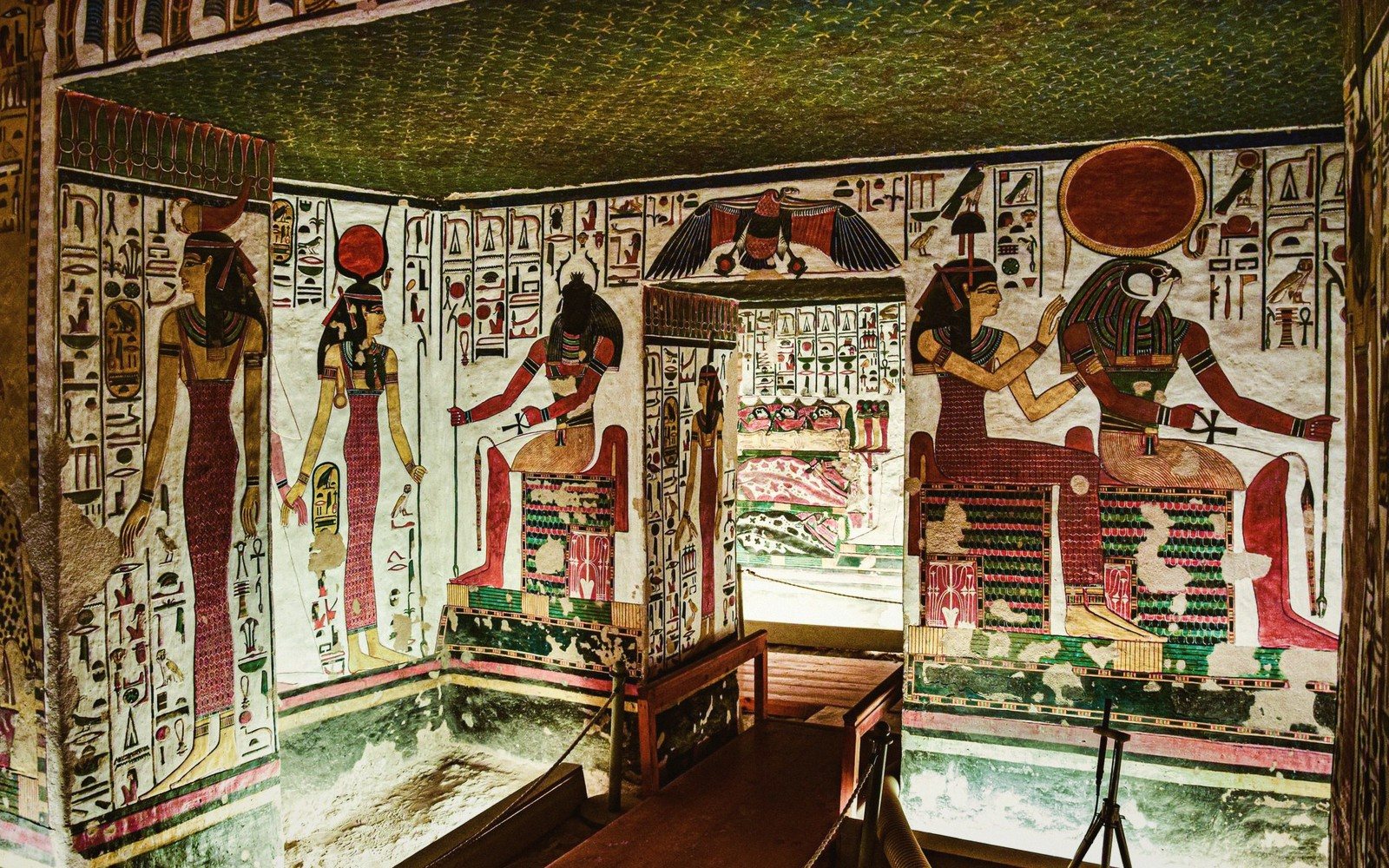
A remote desert gorge on Luxor's West Bank holds the burial chambers of Egypt's greatest rulers. Why tombs went underground — and what fills every inch of the walls.
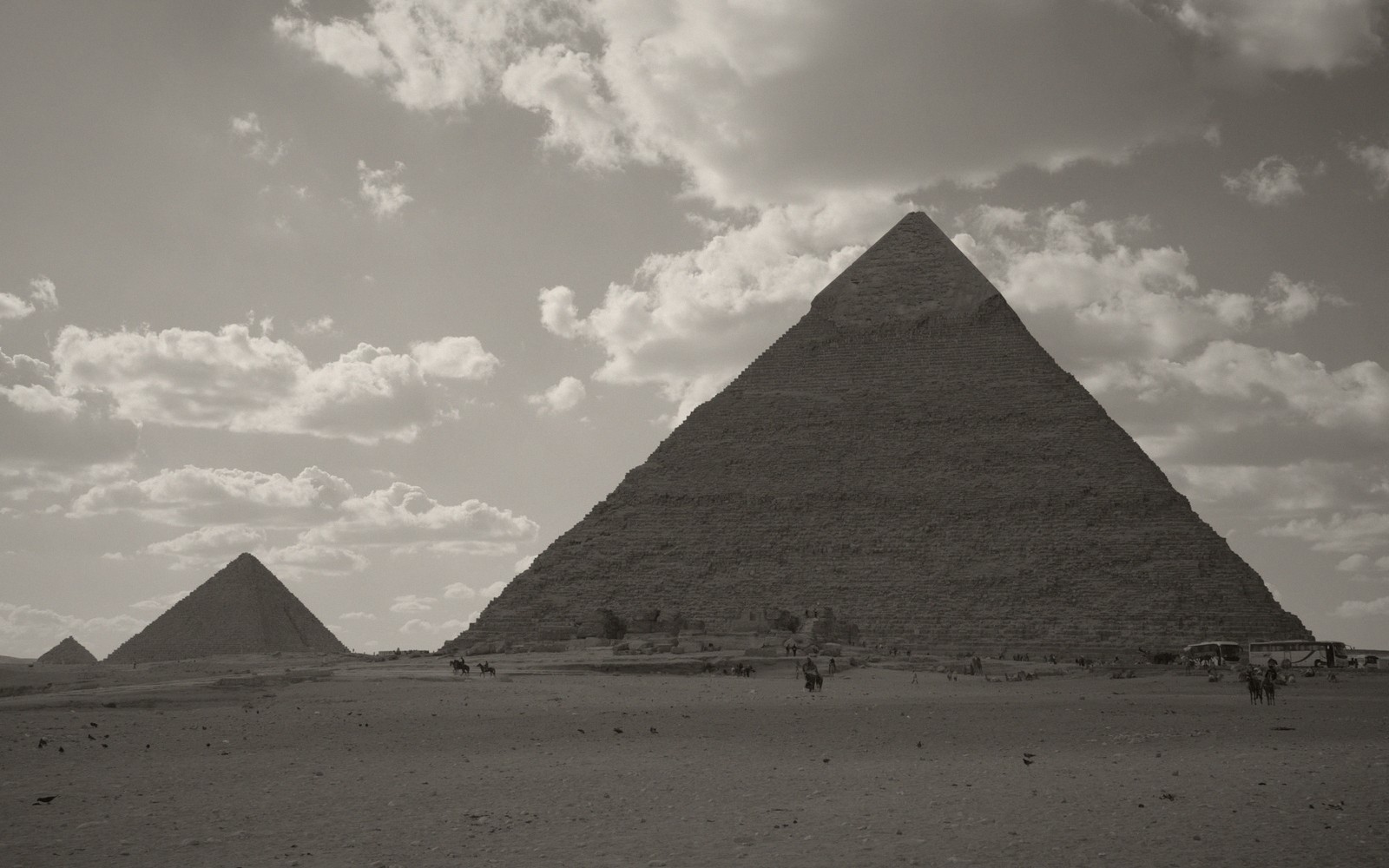
The pyramids failed. By the end of the Old Kingdom, robbers had penetrated virtually every royal burial at Giza and Saqqara, stripping the chambers of everything portable. The monument that announced the presence of a royal tomb — its entire purpose — also marked the spot for anyone willing to dig. By the New Kingdom, the pharaohs and their advisors drew a different conclusion: conceal the tomb entirely. Separate the burial chamber from the mortuary temple, hide the first and build the second somewhere else, and choose a location where the guards could watch every entrance and exit.
The Valley of the Kings — known in ancient Egyptian as Ta Set Aat, "the Great Place" — is a narrow, high-walled gorge cut into the limestone cliffs of the Theban hills, roughly several kilometres inland from the floodplain. A single winding path once controlled access from the river side. The cliffs are nearly vertical in places, natural walls that made surveillance straightforward. And directly above the valley, the peak the ancient Egyptians called Dehenet — the one Europeans later named el-Qurn — rises to a natural pyramid shape, a piece of geography that may have made the location feel ordained.1
The first king definitively buried here was Thutmose I, early in the Eighteenth Dynasty, around 1500 BCE. His tomb was cut directly into the rock — no superstructure, no marker visible from above. The burial chamber was deep inside, reached by descending corridors that bent and doubled back. For over four centuries, from roughly the early Eighteenth to the late Twentieth Dynasty, the valley received the bodies of Egypt's pharaohs. By the end, archaeologists had numbered more than sixty tombs; the catalogue runs to KV62 (KV for "Kings' Valley") and beyond, with small pit-graves and unfinished shafts counted alongside the great royal chambers.
01What Is on the Walls
When you step into a decorated royal tomb, you are entering a three-dimensional religious book. Every surface — walls, ceilings, even the pillars — carries text and image from a series of funerary compositions whose purpose was navigation: they mapped the journey the dead king had to make through the twelve hours of the night in order to be reborn with the sun at dawn.
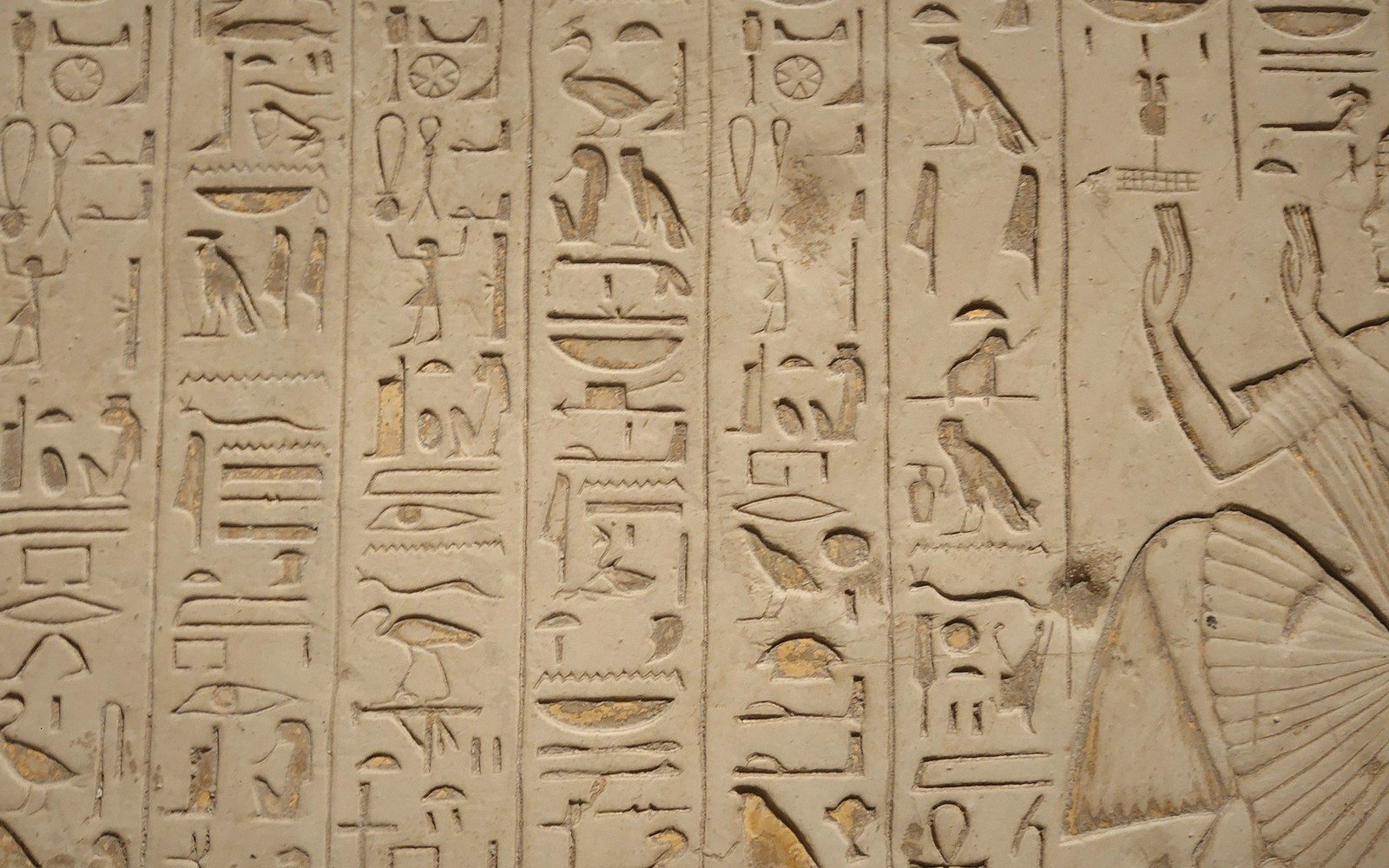
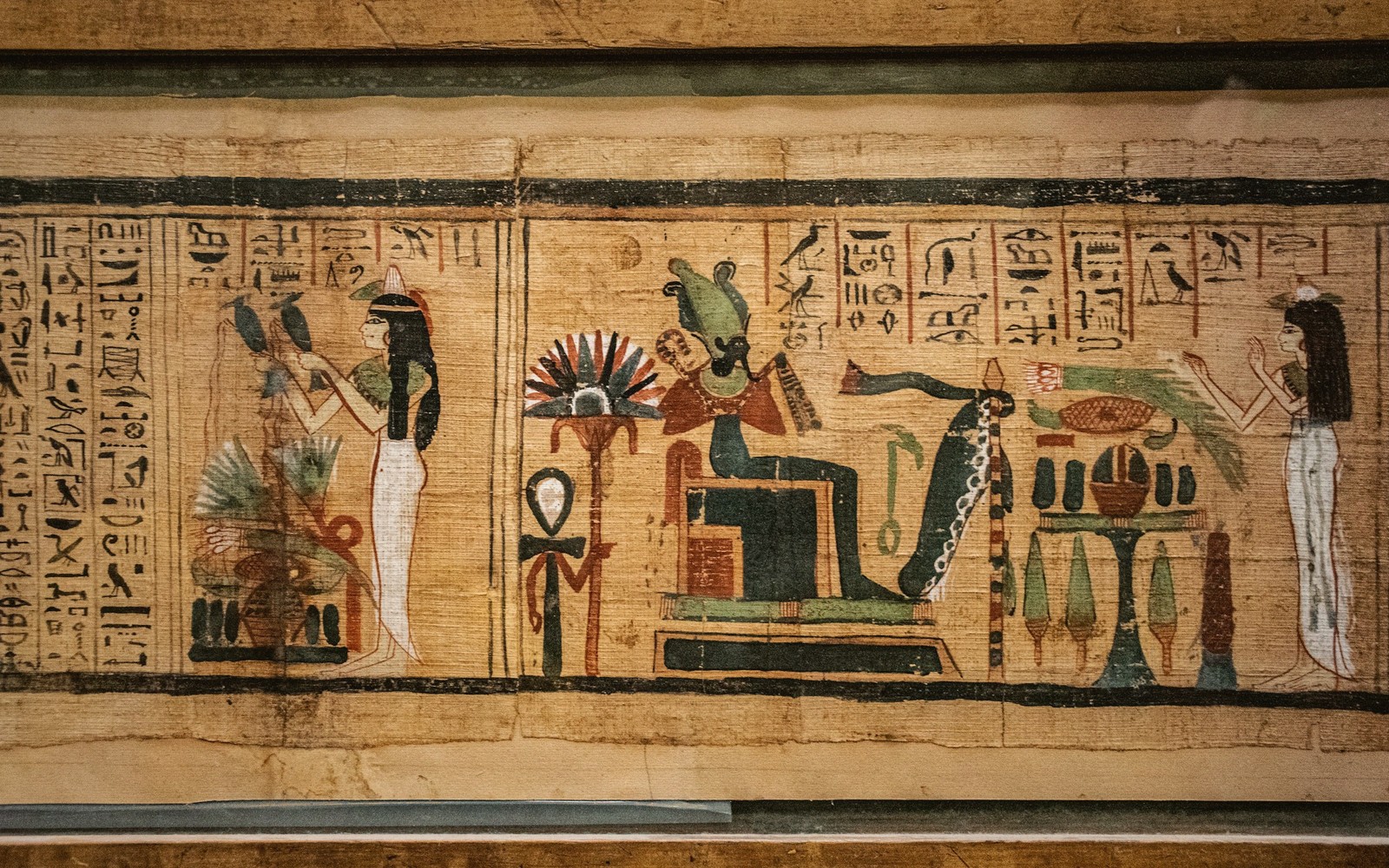
The oldest of these compositions is the Amduat, the Book of What Is in the Underworld, which appears in its complete form in the tomb of Thutmose III (KV34). It charts the nocturnal journey of the sun god Ra through twelve caverns, one per hour, encountering the blessed dead, the damned, and the guardians who stand at each gate. The text is dense — columns of hieroglyphs interspersed with figures drawn in an almost diagrammatic style, outlined in red and black on a buff-yellow ground that imitates painted papyrus. In Thutmose III's burial chamber, the figures are rendered as stick-like forms of deliberate archaism, as if the painter were copying an older scroll.
Later tombs introduce new compositions alongside or instead of the Amduat. The Book of Gates appears in the tomb of Horemheb (KV57), organising the underworld around a series of gates rather than caverns, each guarded by a serpent and requiring the correct password. The Book of Caverns and the Book of the Earth treat the underworld as a landscape of pits and mounds from which solar regeneration emerges. The Litany of Ra, found in the corridors of many Nineteenth and Twentieth Dynasty tombs, opens with seventy-five acclamations of the sun god in different forms. These are not competing theologies so much as overlapping maps drawn from different angles.2
These are not competing theologies so much as overlapping maps drawn from different angles.
The ceiling of the burial chamber in the tomb of Seti I (KV17) carries an astronomical composition — the oldest known preserved astronomical ceiling in Egypt — showing the northern constellations and the decans, the thirty-six groups of stars whose heliacal risings divided the Egyptian year. The tomb of Seti I is the longest and most elaborately decorated in the valley, its paintings still carrying traces of colour so clean they read almost as fresh work; it also remains largely closed to visitors to protect the surfaces.
The tomb most people enter is that of Ramesses VI (KV9), a vast corridor-tomb whose ceiling carries the complete Book of the Day and Book of the Night, the solar barque moving in opposing arcs across the sky. At the far end of each passage, the two journeys meet in an enormous figure of Nut — the sky goddess — shown arching her body across the ceiling of the burial hall, swallowing the sun at evening and giving birth to it at dawn. It is one of the most complete cosmological statements in Egyptian art.
02The Tomb of Tutankhamun
KV62 is the smallest decorated royal tomb in the valley, and the most visited in the world. Tutankhamun was a minor king of the late Eighteenth Dynasty who died young, probably in his late teens. His tomb, discovered largely intact by Howard Carter in 1922, contained over five thousand objects — not because Tutankhamun was especially powerful or wealthy, but because the burial had never been properly robbed. Every other royal tomb in the valley was stripped in antiquity, most of them during the late New Kingdom when state authority had weakened enough to allow systematic looting.3
The tomb's paintings are modest by royal standards: only the burial chamber is decorated, its four walls showing the opening of the mouth ceremony, the king's funeral procession, and his reception by the gods of the afterlife. The famous treasures — including the gold mask — are now in the Egyptian Museum in Cairo. What the tomb provides, stripped of its contents, is a sense of scale: the chamber that held the most famous archaeological find in history is not much larger than a generous hotel room.
03Visiting the Valley
The valley holds dozens of tombs but only a fraction are open at any time, rotating on a programme designed to reduce humidity damage. A standard ticket admits three tombs from the general rotation; the tombs of Tutankhamun, Seti I and a handful of others require separate tickets. The tomb of Ramesses VI is generally open and offers the most complete wall programme accessible to casual visitors.
The site sits on Luxor's West Bank, reached by road or by the short river crossing from the East Bank town. A small electric train runs the length of the walled approach road from the visitor centre to the tomb entrances. Early morning visits, before organised groups arrive in numbers, allow closer, quieter reading of the walls — which is what the valley rewards above all else. These were not monuments meant to be looked at. They were meant to be read.
Chronology
- c.1500 BCEThutmose I buried here; valley established as royal necropolis
- c.1336–1327 BCEreign of Tutankhamun; KV62 prepared and sealed
- c.1294–1279 BCEreign of Seti I; KV17 excavated, most elaborate decoration in valley
- 1279–1213 BCEreign of Ramesses II; KV7 prepared (largely inaccessible today)
- Late Twentieth Dynastysystematic looting of tombs as state authority weakened
- 1922 CEHoward Carter opens KV62 intact
Named in this guide
Thutmose I (Eighteenth Dynasty)
first king definitively buried in the valley
Thutmose III (KV34)
tomb contains earliest complete Amduat
Seti I (KV17)
longest tomb; carries oldest preserved astronomical ceiling in Egypt
Horemheb (KV57)
tomb contains early complete version of the Book of Gates
Notes
- 1
The paintings are books, not decoration. Each wall is a chapter with a title, and the sequence runs with the corridor. ↩
- 2
Tutankhamun’s tomb is small and plain because it was not built for him. The contents made it famous, and the contents are elsewhere. ↩
- 3
Three tombs, slowly, beat six at speed. The eye stops reading after about an hour underground. ↩