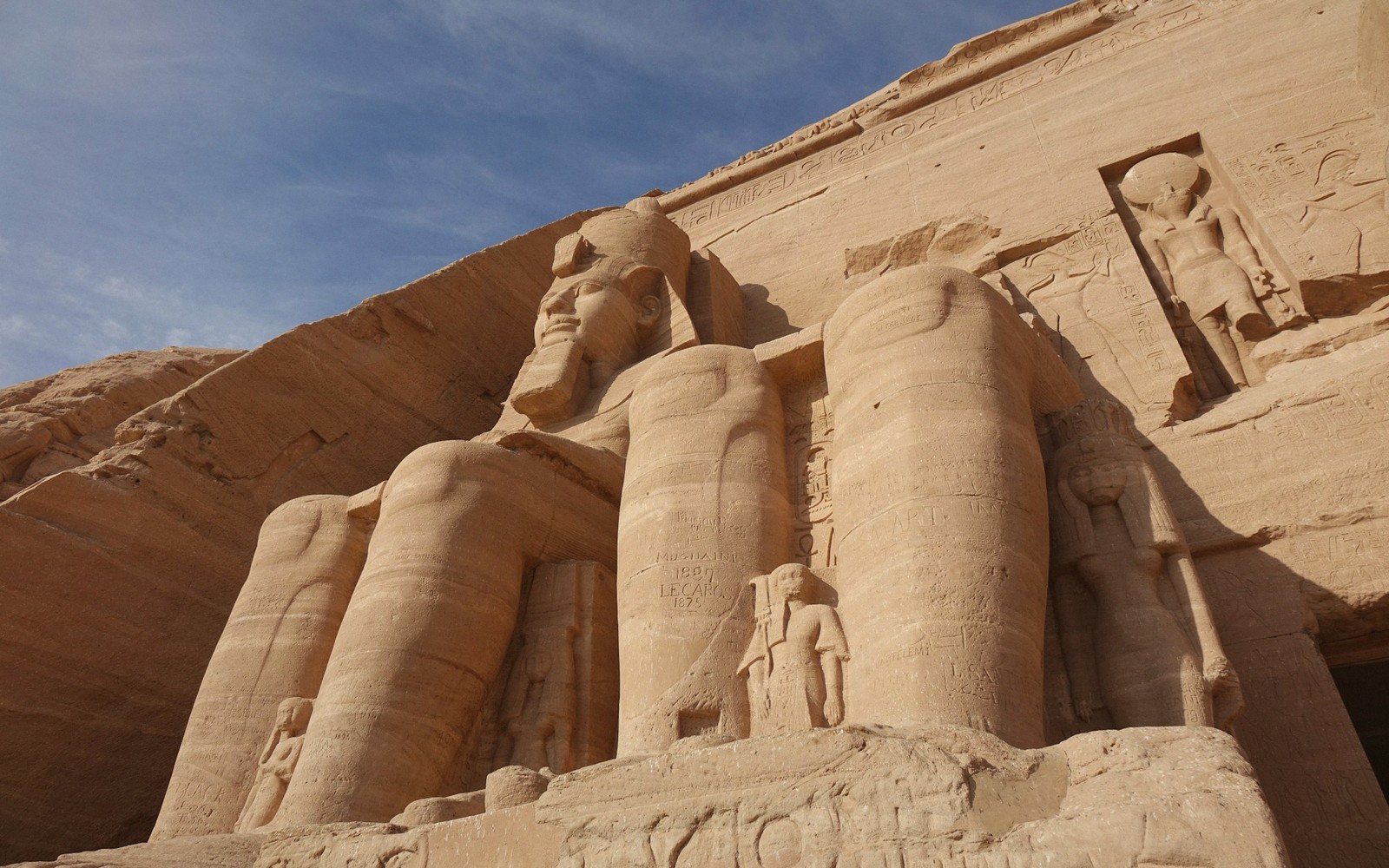
Ramesses II built it to last forever. It was moved anyway — and the fact that it survived at all is one of the stranger stories in modern archaeology.
Abu Simbel sits on the west bank of Lake Nasser, roughly 280 kilometres south of Aswan, so close to what was once the Nubian frontier that its location was the point. Ramesses II, who ruled for some 66 years in the 13th century BCE, cut two temples from the living sandstone of a cliff during the middle decades of his reign. The Great Temple was his own: four seated colossi of the king, each around 20 metres tall, flank the entrance and face east with geometric precision. Twice a year — around 22 February and 22 October — the rising sun penetrates the entire depth of the temple, travelling roughly 60 metres through the rock to illuminate the sanctuary statues within. Only the figure of Ptah, god of darkness, remains in shadow. Whether the alignment was calculated to mark the king's birthday and coronation, or for some other astronomical purpose, remains contested; that it was deliberate is not.
The interior is carved with reliefs describing Ramesses's wars, most famously the Battle of Kadesh against the Hittites, fought around 1274 BCE — a battle the Egyptians did not win outright but which Ramesses spent much of his reign presenting as a triumph. The smaller temple nearby, dedicated to the goddess Hathor and to Ramesses's wife Nefertari, is unusual enough to deserve its own attention: Egyptian queens very rarely received their own temple, and Nefertari's colossi stand the same height as those of the king, an honour without close parallel.1
01The Rescue
When Egypt began building the Aswan High Dam in the 1960s, the resulting reservoir — Lake Nasser — was going to swallow Abu Simbel entirely. UNESCO coordinated an international rescue campaign involving engineers, archaeologists and governments from across the world. Between 1964 and 1968 both temples were cut into more than a thousand numbered blocks, each weighing up to 20 tonnes, lifted from the original cliff and reassembled 65 metres higher and 200 metres further from the river on an artificial hill built to match the original profile. Reinforced concrete domes hidden inside the artificial hill carry the load that the rock itself once bore.
The precision required was extraordinary. The blocks had to be repositioned so that the solar alignment would still function — and it does, though the dates have shifted by approximately one day relative to when they fell in antiquity, a consequence of the slight change in orientation during reconstruction. The colossi's faces were among the most photographed problems of the operation: cutting through the sandstone noses and chins of 20-metre statues without losing detail required slow, deliberate work with hand tools. One of the colossi had already partially collapsed in antiquity, probably as a result of an earthquake, and that damage was preserved rather than corrected.2
One of the colossi had already partially collapsed in antiquity, probably as a result of an earthquake, and that damage was preserved rather than corrected.
The project cost around 40 million US dollars, funded by contributions from roughly 50 countries. It was one of several Nubian monuments rescued before the flood — others were dismantled and gifted abroad, and today temples from this campaign stand in Turin, Madrid, New York and Leiden — but Abu Simbel was the largest and most complex operation by a margin.
| As cut | As standing now | |
|---|---|---|
| Ground | Living cliff face above the river | An engineered hill of concrete and fill |
| Height | River level | Some sixty-five metres higher |
| Approach | From the water | From behind, through the artificial dome |
02What to Expect on the Ground
Most visitors arrive by road or by a short flight from Aswan. The site opens early, and in the cooler months a dawn visit earns the full spectacle of the colossi emerging from the dark — the east-facing aspect that Ramesses intended, though he never saw an electric floodlight. The son-et-lumière offered in the evenings is a separate and optional experience.
The join lines between the cut blocks are visible on close inspection, and the artificial hill has ventilation windows at the back — signs of the rescue operation that are worth noticing rather than being disappointed by. The temples were saved. That they wear their surgery lightly is, given everything, something close to a miracle of engineering. Stand at the entrance of the Great Temple and look back across the lake: the water that covers the original cliff is perfectly still, and there is no trace of what lies beneath.
Chronology
- 13th century BCERamesses II cuts both temples from the cliff
- c. 1274 BCEBattle of Kadesh depicted in temple reliefs
- 1960sconstruction of the Aswan High Dam begins
- 1964–1968UNESCO-coordinated relocation of the temples
Named in this guide
Ramesses II
New Kingdom pharaoh who commissioned both Abu Simbel temples
Nefertari
chief wife of Ramesses II; honoured with the smaller temple
Ptah
god of darkness and craftsmen; sole sanctuary statue left unlit at dawn
Hathor
goddess of love and music; namesake deity of the smaller temple