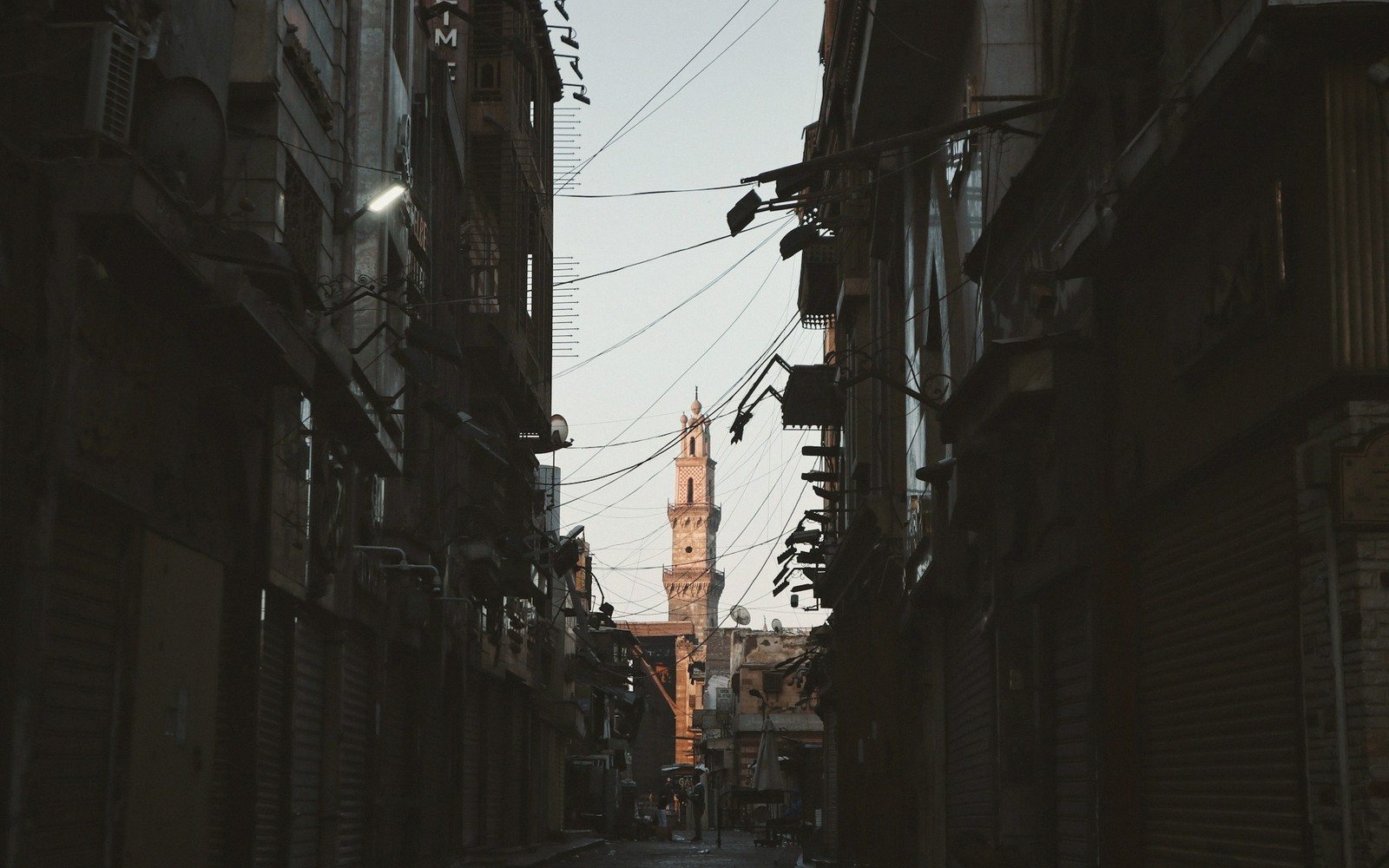
A thousand years of mosques, mausoleums and medieval lanes packed into a walkable few kilometres of the old city
Cairo is not where you might expect it. The Pharaonic capital was Memphis, south of the modern city. The Ptolemies built Alexandria on the Mediterranean coast. It was the Arab conquest of 641 CE that seeded the settlement that would eventually become Cairo — first the garrison town of Fustat, then al-Qata'i under the Tulunid governor Ibn Tulun, and finally al-Qahira, "the Victorious," founded by the Fatimid general Jawhar al-Siqilli in 969 CE as a walled royal city north of the older quarters. Al-Qahira gave the modern city its name and its medieval heart.
That heart is the district Egyptians call al-Darb al-Ahmar, al-Muizz Street and the surrounding warren of lanes collectively labelled, somewhat loosely, the Islamic Quarter or Historic Cairo. Unesco added it to the World Heritage List in 1979. Its boundaries are porous, but the practical core is compact: roughly two kilometres of al-Muizz li-Din Allah Street running north to south from Bab al-Futuh down to al-Azhar, with lanes branching east toward the City of the Dead and west toward the Khan el-Khalili bazaar. You can walk the spine in forty minutes if you do nothing but walk. That, however, would be a waste of an extraordinary place.
01The Gates, the Street and the Monuments Along It
Start at the northern gates. Bab al-Futuh and Bab al-Nasr, both completed in 1087 CE under the Fatimid caliph al-Mustansir by the Armenian general Badr al-Jamali, are among the best-preserved medieval city gates anywhere in the Arab world. Their stonework is military architecture taken seriously: semicircular and square towers respectively, with carved inscriptions still readable above the arches. Between them the old city wall runs east; you can walk a section of it from the roof of Bab al-Futuh.1
Step through Bab al-Futuh and you are on al-Muizz Street, named for the Fatimid caliph who first entered his new city through this road in 973 CE. The street became — and remains — a concentrated anthology of Islamic architecture across ten centuries and half a dozen dynasties. The visitor's challenge is not finding monuments but managing the density of them.
A short way south, the Madrasa and Mausoleum of Sultan Barquq (begun 1384 CE) announces the Mamluk period with characteristic confidence: an ablaq stone façade of alternating courses of red and white, a stalactite-vaulted entrance portal called a muqarnas hood, and a minaret with a stone-carved balcony of geometrical intricacy. The Mamluks who ruled Egypt from 1250 to 1517 CE were prodigious builders, in part because a sultan's tomb complex was simultaneously his pious legacy and a visible assertion of legitimacy. Several of the grandest structures on al-Muizz date to this period.
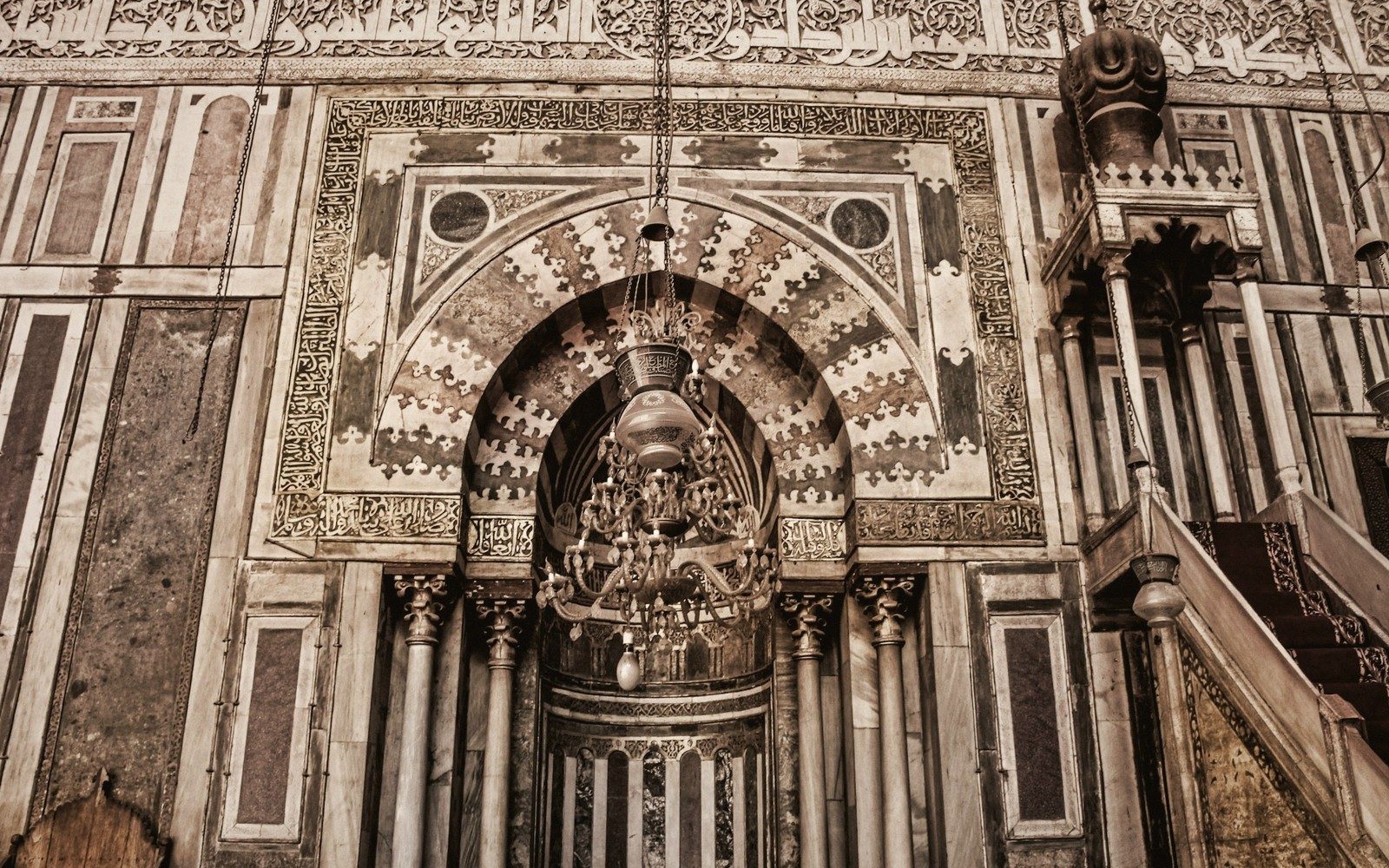
Further south, the Qalawun Complex (1284–85 CE) is the most layered ensemble on the street. Sultan Qalawun built a mausoleum, a madrasa and a bimaristan — a hospital — within a single long façade that still runs for over sixty metres. The mausoleum interior carries a wooden mashrabiyya screen (a finely turned-lattice wooden grille) and a dome resting on an octagonal drum, with stucco panels and mother-of-pearl inlay that show how much Fatimid and Crusader decorative detail the Mamluks absorbed and transformed. The bimaristan functioned as a hospital into the nineteenth century.
Across the street, the Madrasa of al-Nasir Muhammad (1304 CE) shows a façade borrowed almost wholesale from a Gothic doorway stripped from a Crusader church — the pointed arch, the carved vine scroll and the moulded frame transported stone by stone, probably from Acre after its fall in 1291 CE. It sits without embarrassment beside Mamluk stonework, which is part of what makes this street so alive: it has never been a period room, always a working city that consumed what it found useful.2
Al-Muizz ends at al-Azhar Street, but the quarter extends well beyond it.
02Deeper into the Quarter: Lanes, Courtyards and the Mosque of Ibn Tulun
Al-Muizz ends at al-Azhar Street, but the quarter extends well beyond it. Press southeast from the Qalawun complex and you reach al-Darb al-Ahmar, the Red Road, a neighbourhood of smaller mosques, Ottoman sabil-kuttab (combined public fountain and Quranic school) buildings and domestic architecture in varying states of restoration. The Mosque of Aqsunqur (the Blue Mosque, 1347 CE, refaced with Iznik tile in the seventeenth century) is here, its blue-and-white interior an unexpected Ottoman intrusion into a Mamluk shell.
Walk west and south from the bazaar district and you reach a different kind of monument. The Mosque of Ibn Tulun, completed in 879 CE, is the oldest mosque in Cairo to survive largely in its original form — and one of the largest courtyard mosques in the world. Ahmad ibn Tulun was the Abbasid governor who declared near-independence and built his own city, al-Qata'i, north of Fustat. Almost all of al-Qata'i was demolished after his dynasty fell; the mosque alone survived. Its plan follows Samarra in Iraq, where Ibn Tulun grew up: a vast open sahn (courtyard) surrounded by arcades, a spiral minaret on the exterior closely related to the Great Mosque of Samarra's famous helical tower, and pointed arches carried on brick piers rather than the columns typical of Fatimid work. The stucco soffits along the arcade are carved with Quranic text and foliate pattern in a style that feels strikingly different from what came after. Give it time; the scale is the point.
Adjacent to Ibn Tulun, the Gayer-Anderson Museum occupies two seventeenth-century houses joined internally, their qa'a (formal reception halls with raised iwan alcoves), mashrabiyya windows and painted ceilings preserved through the idiosyncratic collecting passion of a British officer who lived there from 1935 to 1942. As a document of domestic architecture, it complements the mosques usefully: the same decorative language of lattice, inlay and geometric tile applied to private life rather than public piety.3
03Practical Notes for the Walk
The walk from Bab al-Futuh to Ibn Tulun covers roughly three kilometres as the crow flies; the lanes add considerably to that. Morning light enters the street from the east and is flattering on the stone facades before midday. Al-Muizz Street itself was pedestrianised along its northern stretch, making the stroll considerably easier than it was a generation ago. Friday mornings are quieter than any afternoon; Friday lunchtimes fill the lanes again.
Dress conservatively. Mosques and mausoleums require covered shoulders and legs, and most ask visitors to remove shoes — carry a bag to hold them rather than leaving them at the door. The interiors are cool: a welcome practical reason to step inside.
The density of what is packed into these streets can produce a kind of monument fatigue by early afternoon. A better strategy than pushing through is to choose a smaller number of sites — the gates and their wall, Qalawun, Ibn Tulun — and look at each one properly, reading the surfaces as the architecture intends. A muqarnas vault is not background decoration; it is a calculated mathematical exercise in transforming a square base into a circular dome, each small cell supporting the next. Once you have looked at one long enough to understand the logic, every other such vault you encounter falls into place.
A city that has been continuously inhabited and continuously built upon since the tenth century carries its history lightly, as habit rather than display. Al-Muizz Street is not a museum reconstructed for visitors. The tea shops occupy the same stone portals as the medieval merchants' stalls. That continuity — unremarkable to residents, quietly astonishing to everyone else — is the real reason to walk slowly.
Chronology
- 641 CEArab conquest; garrison town of Fustat established
- 879 CEIbn Tulun completes his mosque; al-Qata'i period
- 969 CEFatimid founding of al-Qahira
- 973 CECaliph al-Muizz enters the new city
- 1087 CEBab al-Futuh and Bab al-Nasr built under Badr al-Jamali
- 1250–1517 CEMamluk dynasty; golden age of monument-building on al-Muizz
- 1284–85 CEQalawun Complex constructed
- 1304 CEMadrasa of al-Nasir Muhammad with Crusader Gothic doorway
- 1384 CEMadrasa and Mausoleum of Sultan Barquq begun
- 1935–1942Gayer-Anderson occupies the houses now bearing his name
Named in this guide
Jawhar al-Siqilli
Fatimid general who founded al-Qahira in 969 CE
Ahmad ibn Tulun
Abbasid governor who built al-Qata'i and its mosque, 870s CE
Badr al-Jamali
Armenian general and Fatimid vizier who built the northern gates
Sultan Qalawun
Mamluk sultan, builder of the great complex on al-Muizz, d. 1290
Notes
- 1
Read every elevation in three zones: altered shopfronts, the portal band, then minaret and dome. The top two date the building. ↩
- 2
Domestic architecture survives in the alleys, not on the spine. Turn off it often. ↩
- 3
Walk north to south in the morning: the light stays off the facades and the crowd builds behind you. ↩