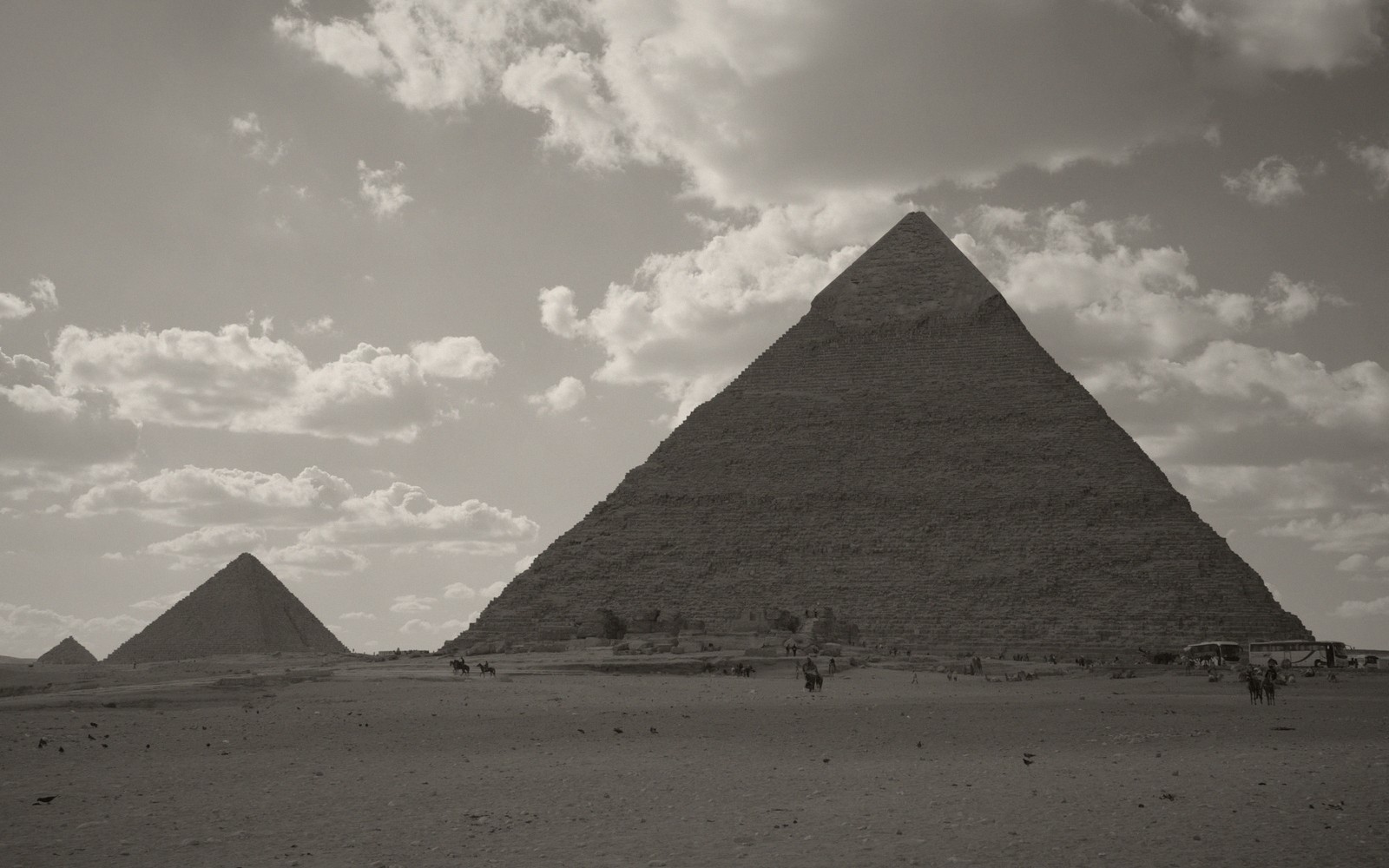
The plateau seen whole: three pyramids, three causeways, one quarry and a plan that rewards attention.
Every visitor arrives with the same photograph already in their head — the three triangles lined up against the sky. What that image never shows is the system behind them. The Giza plateau is not a cemetery in any ordinary sense. It is a precisely engineered complex: each pyramid paired with a mortuary temple on its east face, connected by a long stone causeway to a valley temple at the desert's edge, where the flood plain began and boats could dock. Procession, ritual and the movement of the dead all flowed along that axis. Stand on the plateau and trace the lines of the causeways; suddenly the geometry is legible.
The Great Pyramid of Khufu — built during the Fourth Dynasty, in the mid-third millennium BCE — is the largest and the oldest of the three. Its original height was around 146 metres, and it held that record for the better part of four thousand years. Khufu's son Khafre built the second pyramid slightly to the south-west, and the arrangement creates an optical illusion: Khafre's pyramid looks taller because it sits on higher ground and retains its limestone casing near the apex. The third pyramid, built by Menkaure, is dramatically smaller but no less carefully placed. Together, they step diagonally across the plateau in a pattern that has prompted much speculation and modest scholarly consensus: the positioning was probably dictated by the underlying rock and the need to keep each complex visually separate rather than by astronomical alignment, though the cardinal orientations are precise.1
01The Sphinx, the Causeway and the Quarry
The Great Sphinx crouches at the lower, eastern end of Khafre's causeway, carved from a knoll of natural limestone left standing when the plateau was quarried. Its body is soft nummulitic limestone that has weathered badly; the head, cut from harder rock, has survived better. For most of its history the Sphinx was buried to the neck in sand — ancient texts record clearances under Thutmose IV, who left a stele between the paws describing a dream in which the Sphinx promised him kingship if he cleared the encroaching desert. The stele is still there.
Khafre's valley temple, immediately south of the Sphinx, is among the best-preserved Old Kingdom buildings in Egypt. Its massive pink granite pillars and alabaster floor survive largely intact — an austere, powerful space that repays a slow walk even after the pyramids themselves have absorbed the morning.2
Khafre's valley temple, immediately south of the Sphinx, is among the best-preserved Old Kingdom buildings in Egypt.
The quarry that supplied much of the core limestone is not a side-note: it is right there on the plateau, forming the depression to the south and east of the Great Pyramid. Workers cut the stone in place and dragged it on sledges; a workers' settlement excavated since the 1990s by a team from the Ancient Egypt Research Associates revealed bakeries, breweries and a remarkably organised administrative infrastructure. These were not enslaved labourers but a rotating workforce of skilled and semi-skilled workers, housed and fed by the state.
02How to Read the Site
The temptation at Giza is to photograph and move on. Resist it. The plateau rewards a circuit: walk the perimeter of the Great Pyramid, noting the massive core blocks and the fragments of white casing stone still in place at the base. Find Khufu's solar boat museum on the south side, where one of two buried cedar barques has been reassembled — over forty metres of mortise-and-tenon joinery, dismantled and re-fitted in a pit sealed for four and a half millennia. Cross to Khafre's complex for the valley temple. Then climb slightly south for the panoramic view that shows all three pyramids together with their causeways radiating east.
The pyramid cartouches inside the burial chambers are sparse — these kings let their architecture do the speaking. What the walls lack in paint they compensate for in engineering so exact that even now, a sheet of paper will barely pass between some of the casing blocks.
Chronology
- mid-third millennium BCEFourth Dynasty; construction of the Giza complex
- reign of Thutmose IVNew Kingdom clearance of sand around the Sphinx; Dream Stele erected
- 1990s onwardexcavation of the workers' settlement by Ancient Egypt Research Associates
Named in this guide
Khufu
Fourth Dynasty pharaoh, builder of the Great Pyramid
Khafre
son of Khufu; built the second pyramid and likely commissioned the Sphinx
Menkaure
builder of the third, smaller pyramid at Giza
Thutmose IV
New Kingdom king; left the Dream Stele between the Sphinx's paws