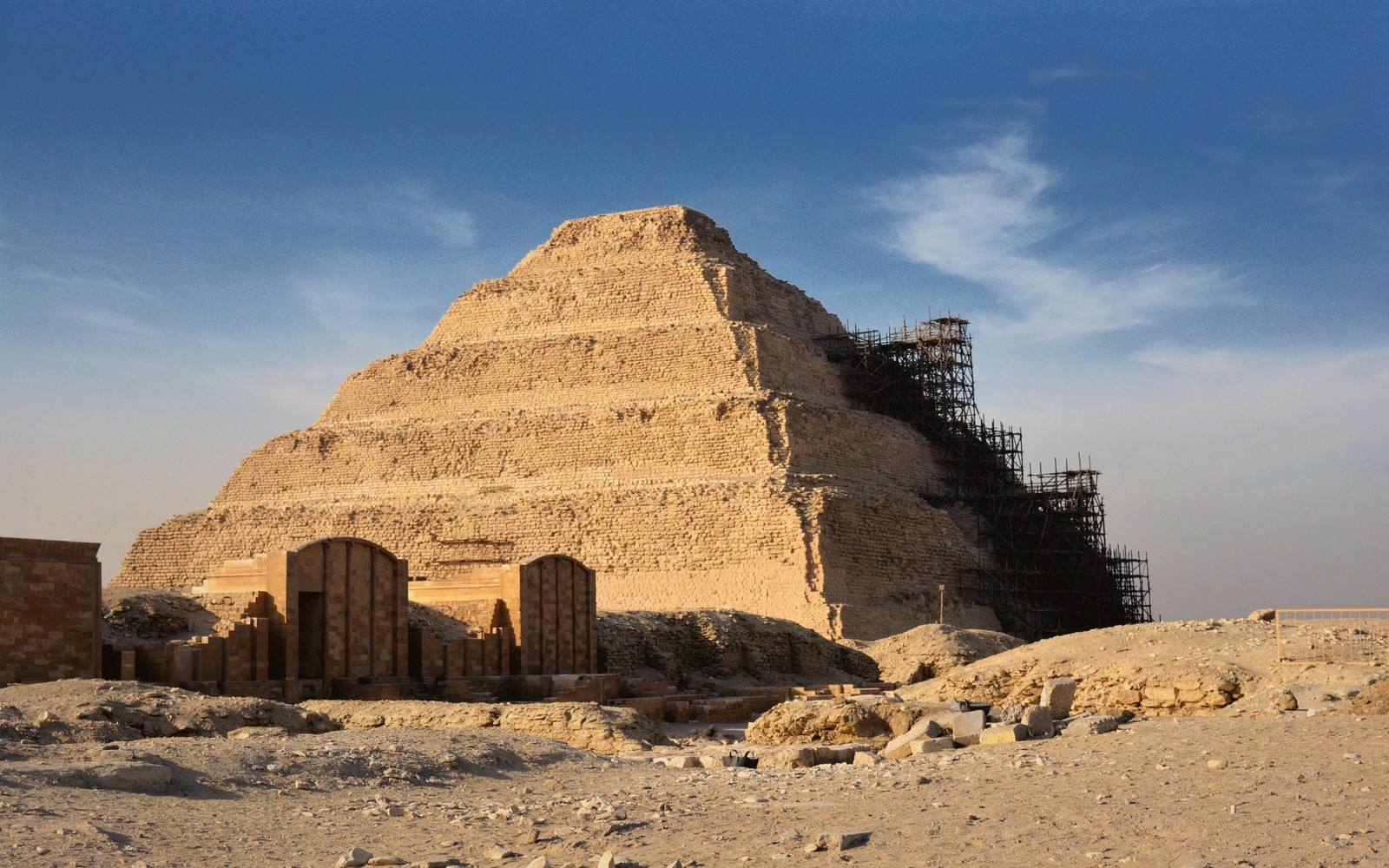
The desert plateau south of Cairo holds the oldest large stone structure on earth — and the single boldest architectural leap in Egyptian history.
Saqqara served as the principal necropolis for Memphis, the ancient capital that sat at the apex of the Nile Delta, where Upper and Lower Egypt converged. The site stretches for roughly six kilometres along the desert escarpment west of the river, and it was in use as a burial ground from the First Dynasty onward — long before the monument that made it famous. The earliest tombs here are mastabas: low, bench-shaped superstructures of mudbrick over underground burial chambers, the standard Egyptian elite tomb of the Early Dynastic period. What happened around 2650 BCE interrupted that convention permanently.
The Third Dynasty pharaoh Djoser commissioned his chief official, Imhotep, to build him a tomb complex at Saqqara. What Imhotep produced was not a refinement of existing forms but a rupture with them. He began with a mastaba and then stacked successively smaller mastabas on top, creating a stepped tower that rose in six stages to approximately sixty metres. The material was limestone — not mudbrick — cut into relatively small blocks and laid with the care of a craftsman unused to working at this scale, because nobody had worked at this scale in stone before. The Step Pyramid of Djoser is the first large-cut-stone structure in the archaeological record. The implications of that fact take a moment to settle.1
01What Imhotep Built, and Why It Matters
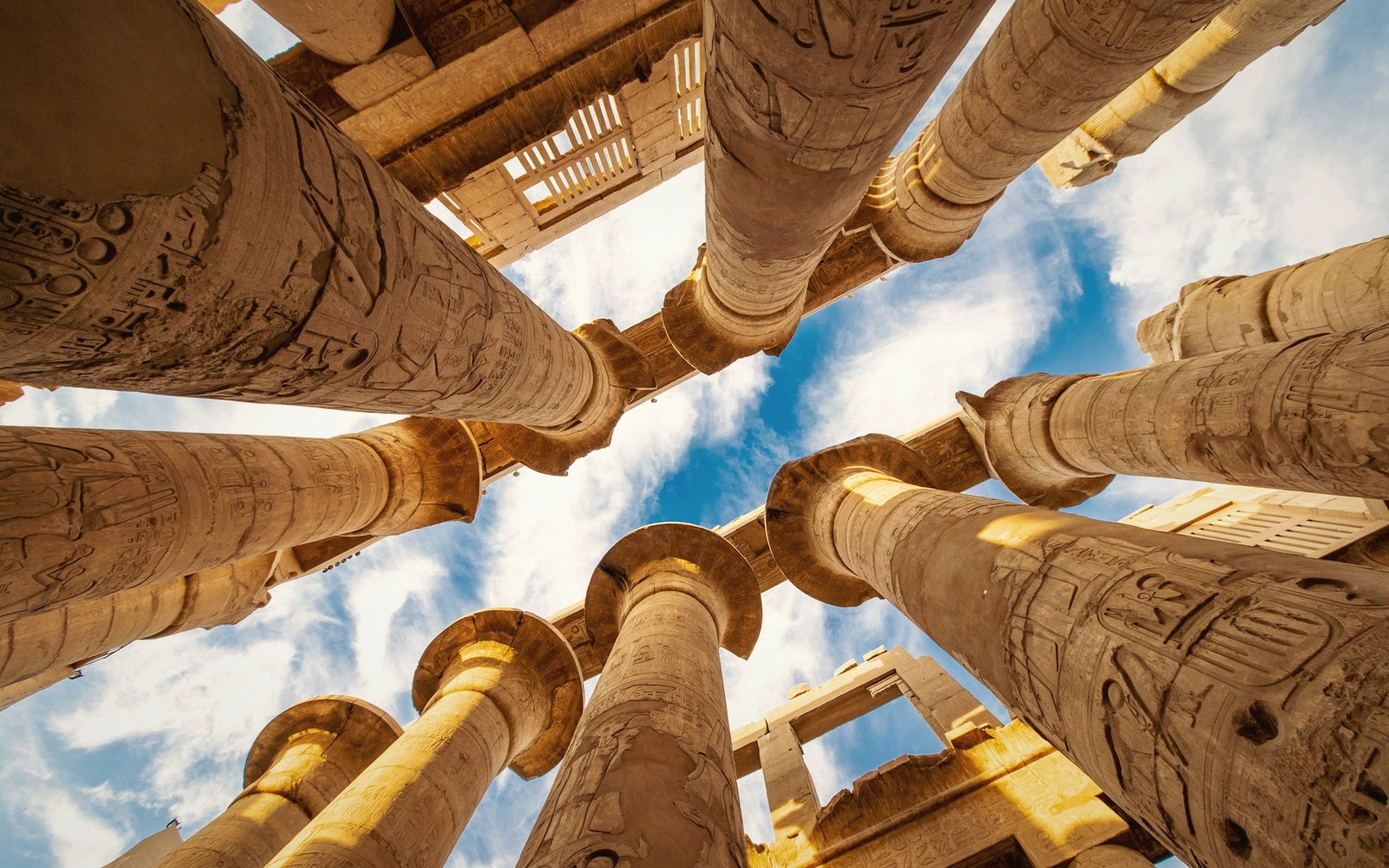
The pyramid itself is only part of what Imhotep designed. Around it he laid out an enclosure of roughly fifteen hectares, walled by a niched limestone perimeter some ten metres high — a monumental translation of the mudbrick palace façade into a new material. Inside, almost everything was false. Dummy chapels with sealed stone doors and simulated wooden roofs line a great court. A colonnaded entrance corridor leads through a forest of engaged limestone columns — half-columns, attached to walls rather than freestanding, because the engineering confidence to let a stone column stand alone had not yet arrived. Imhotep was inventing the vocabulary as he went, and he knew it; many of the chambers and courts have no practical function. They are architecture for eternity rather than for use: storerooms that could never be opened, chapels that could never be entered.
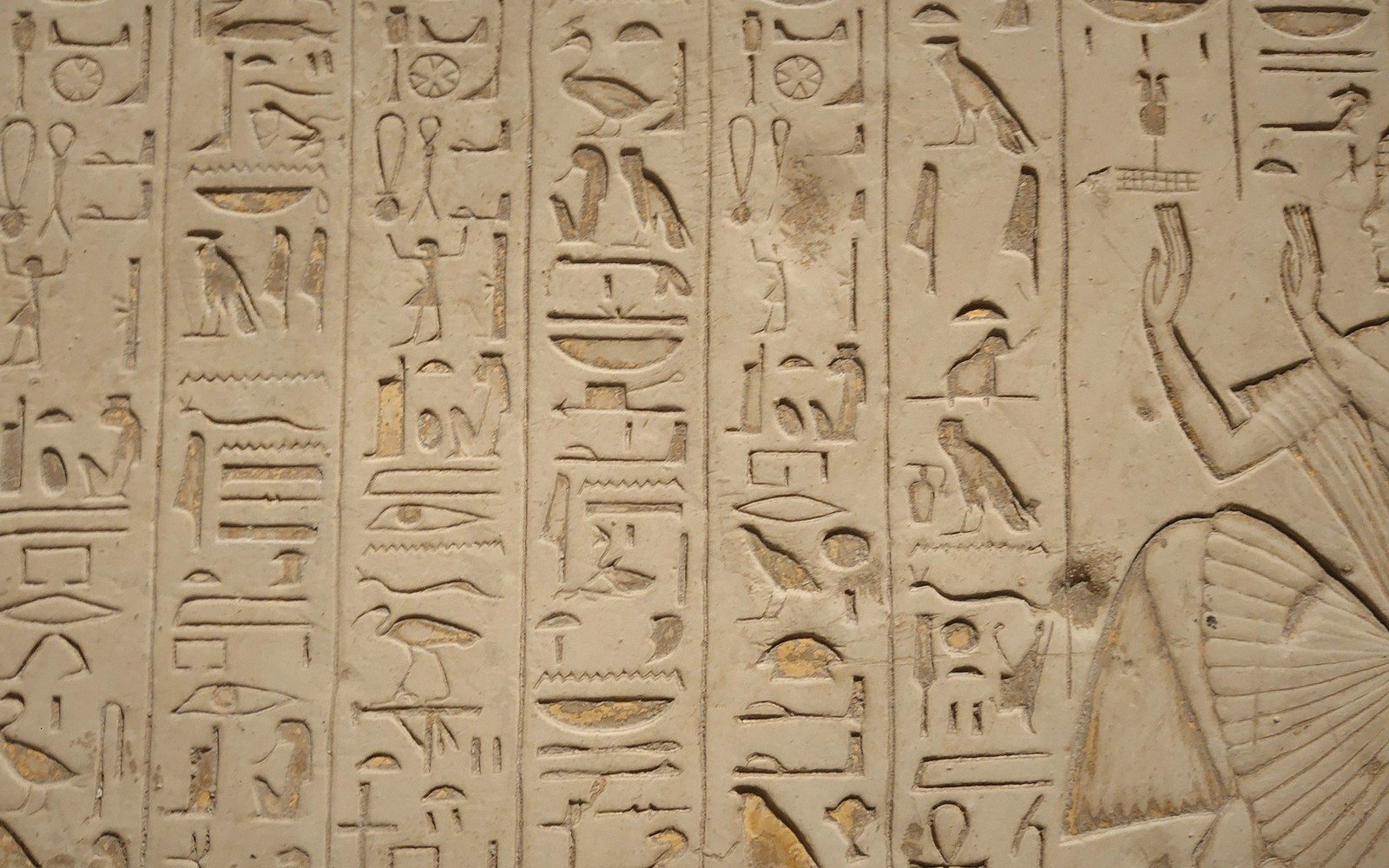
Beneath the pyramid, a labyrinth of galleries was cut into the bedrock, their walls lined with blue-green faience tiles that imitate reed-mat hangings — a subterranean palace for a king who would need one. Some of these galleries yielded thousands of stone vessels inscribed with names reaching back to the First Dynasty, apparently an archive of earlier royal property gathered here for Djoser's use in the afterlife. The burial chamber itself is granite, one of the earliest uses of granite as a structural material in Egyptian architecture — a sign that the builders were already reaching for durability and prestige beyond what local limestone could offer.
In the Late Period he was deified, his cult centred at Saqqara, where a temple to him once stood.
Imhotep's reputation outlasted his own era by millennia. In the Late Period he was deified, his cult centred at Saqqara, where a temple to him once stood. The Greeks later identified him with Asclepius, the god of medicine. Pilgrims came to his precinct at Saqqara well into the Ptolemaic period, depositing mummified ibises by the hundred thousand in the catacombs nearby.2
| Mastaba | Step pyramid | |
|---|---|---|
| Form | Flat-roofed rectangle over a shaft | Six stacked stages, roughly sixty metres |
| Material | Mud brick, later stone-faced | Cut limestone throughout |
| What it added | A marker above a grave | A monument visible from the capital |
02Visiting the Complex
The Step Pyramid enclosure has been subject to decades of conservation and partial restoration — some of the colonnade at the entrance has been re-erected — and approaching it along the restored corridor gives a reasonable sense of what arrival here once felt like. The pyramid itself cannot be entered, but the exterior conveys the scale of the ambition clearly enough from ground level. The surrounding plateau rewards careful exploration: the mastaba field to the north preserves some of the finest painted tomb chapels in Egypt, notably that of Ti, a Fifth Dynasty official, where agricultural and hunting scenes of extraordinary detail cover entire walls. The Serapeum, a vast subterranean gallery cut for the burials of the Apis bulls — sacred animals associated with the god Ptah — is another buried world entirely, the colossal granite sarcophagi still in place.
New Kingdom, Late Period and Greco-Roman tombs continue to emerge from the Saqqara sands, and excavations here produce significant finds regularly. The site rewards the traveller who treats it as a landscape to move through slowly rather than a single monument to photograph and leave.
The plateau sits about thirty kilometres south of central Cairo, accessible by road. A half-day is adequate for the Step Pyramid enclosure and a mastaba or two; a full day opens up the Serapeum, the wider mastaba fields and the lesser-visited southern part of the site. The adjacent site of Dahshur, where the next generation of builders took the step pyramid's logic toward a true pyramid — and twice failed spectacularly before succeeding — is visible from the escarpment, and makes the most natural pairing for anyone following the story of pyramid architecture from its beginning.
Chronology
- Early Dynastic periodmudbrick mastaba tombs at Saqqara
- c. 2650 BCEDjoser and Imhotep build the Step Pyramid
- 5th Dynastymastaba tomb chapels such as Ti's painted and inscribed
- Late PeriodImhotep deified; ibis catacombs in active use
- Ptolemaic periodcontinued pilgrimage cult of Imhotep at Saqqara
Named in this guide
Djoser
Third Dynasty pharaoh who commissioned the Step Pyramid
Imhotep
Djoser's chief official and architect; later deified
Memphis
ancient capital near Saqqara, at the junction of Upper and Lower Egypt
Dahshur
nearby plateau with the Bent Pyramid and Red Pyramid, next step in pyramid evolution