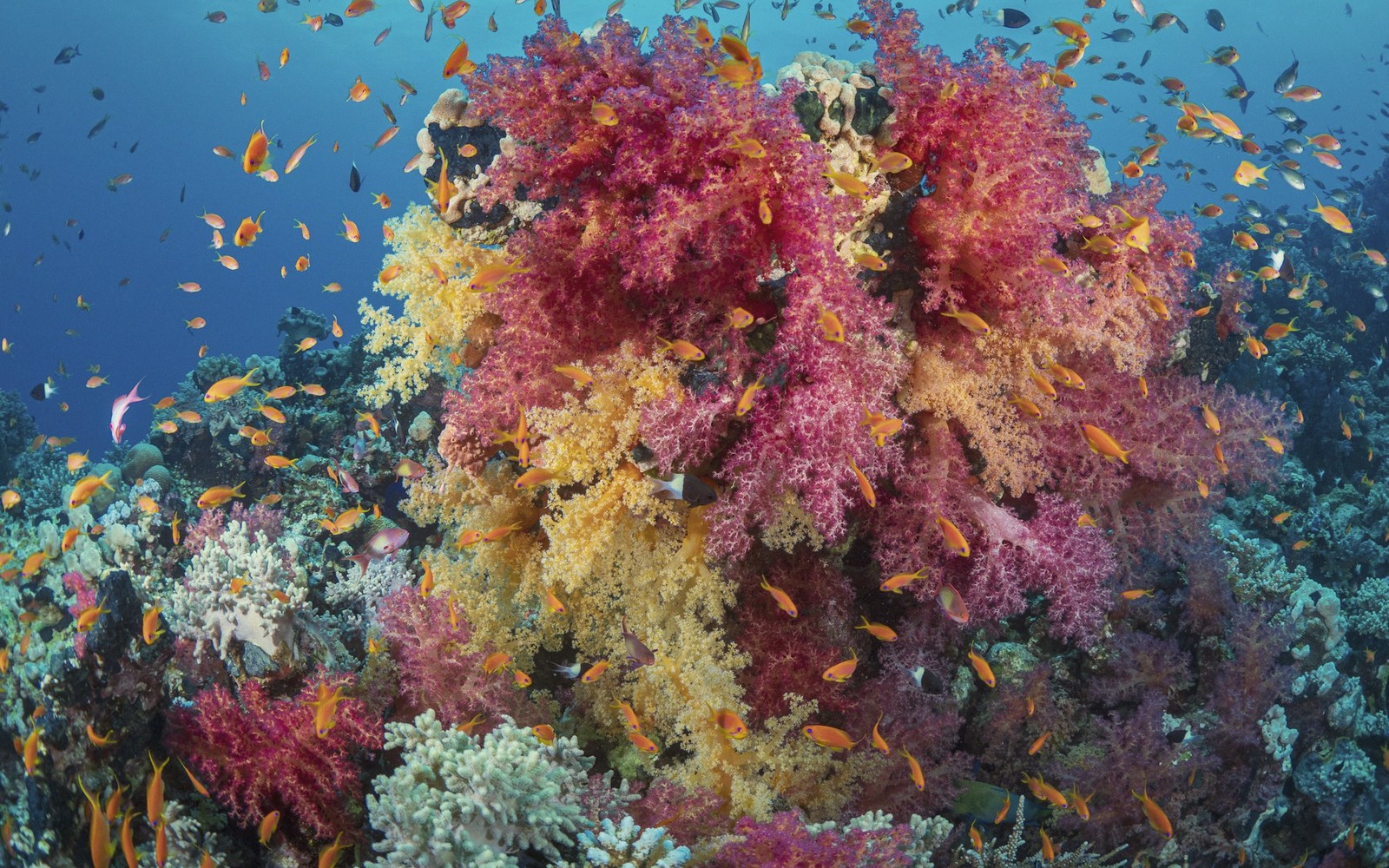
Warm, still and almost completely enclosed — the Red Sea is one of the strangest bodies of water on earth, and its reefs are among the most biodiverse outside the Indo-Pacific.
The Red Sea sits in a rift valley — the same tectonic crack that is slowly pulling Arabia away from Africa. It is narrow, elongated and nearly landlocked, with only the shallow sill at Bab el-Mandeb connecting it to the Indian Ocean. Almost no rivers drain into it. The Nile reaches the Mediterranean, not the Red Sea, which means no sediment clouds the water and no freshwater dilution weakens the salinity. The result is water that is unusually clear, unusually salty and, because of the enclosed basin and intense solar radiation, unusually warm — surface temperatures in the southern Egyptian stretch can exceed 30 °C in summer, yet the corals thrive.1
That survival is itself remarkable. Corals elsewhere bleach and die when water temperatures rise even two or three degrees above their tolerance. Red Sea corals have been exposed to thermal stress for millennia and have evolved a measurable heat resistance that makes them a subject of serious marine science. They are not invincible, but they are tougher than their Pacific or Caribbean relatives, and the reefs here have weathered conditions that would have devastated shallower, less adapted systems.
01What You Are Looking At
The reef structures along Egypt's coastline — most accessibly around Hurghada in the north and Marsa Alam further south — are fringing reefs: they grow directly from the shoreline and drop, often precipitously, into deep water within metres of the surface. The wall dives this creates are among the defining experiences of Red Sea diving: a coral cliff descending from near the surface into blue darkness, encrusted with sea fans, soft corals and sponges at every depth.2
Parrotfish, triggerfish, lionfish and various species of grouper are routine sightings.
The fish assemblages are dense. Parrotfish, triggerfish, lionfish and various species of grouper are routine sightings. Pelagic species — hammerhead sharks, oceanic whitetip sharks, manta rays — pass through the outer reefs and the offshore seamounts called guyots in deeper water. The Brothers Islands, two small outcrops roughly seventy kilometres offshore from the mainland coast, are considered among the finest dive sites in the world precisely because their exposed position attracts open-water species rarely seen on coastal reefs.
The water itself helps the eye. Visibility of twenty to thirty metres is ordinary. On a calm morning the coral gardens are lit from almost directly overhead, and the colours — violet sea fans, orange anthias, the white sand channels between reef heads — are close to what a naturalist's illustration would invent if told to make something implausible look real.
Named in this guide
Hurghada
main northern Red Sea resort and dive hub on Egypt's coast
Marsa Alam
southern Red Sea town, access point for less-visited reefs
The Brothers Islands
two isolated offshore outcrops, world-class dive sites