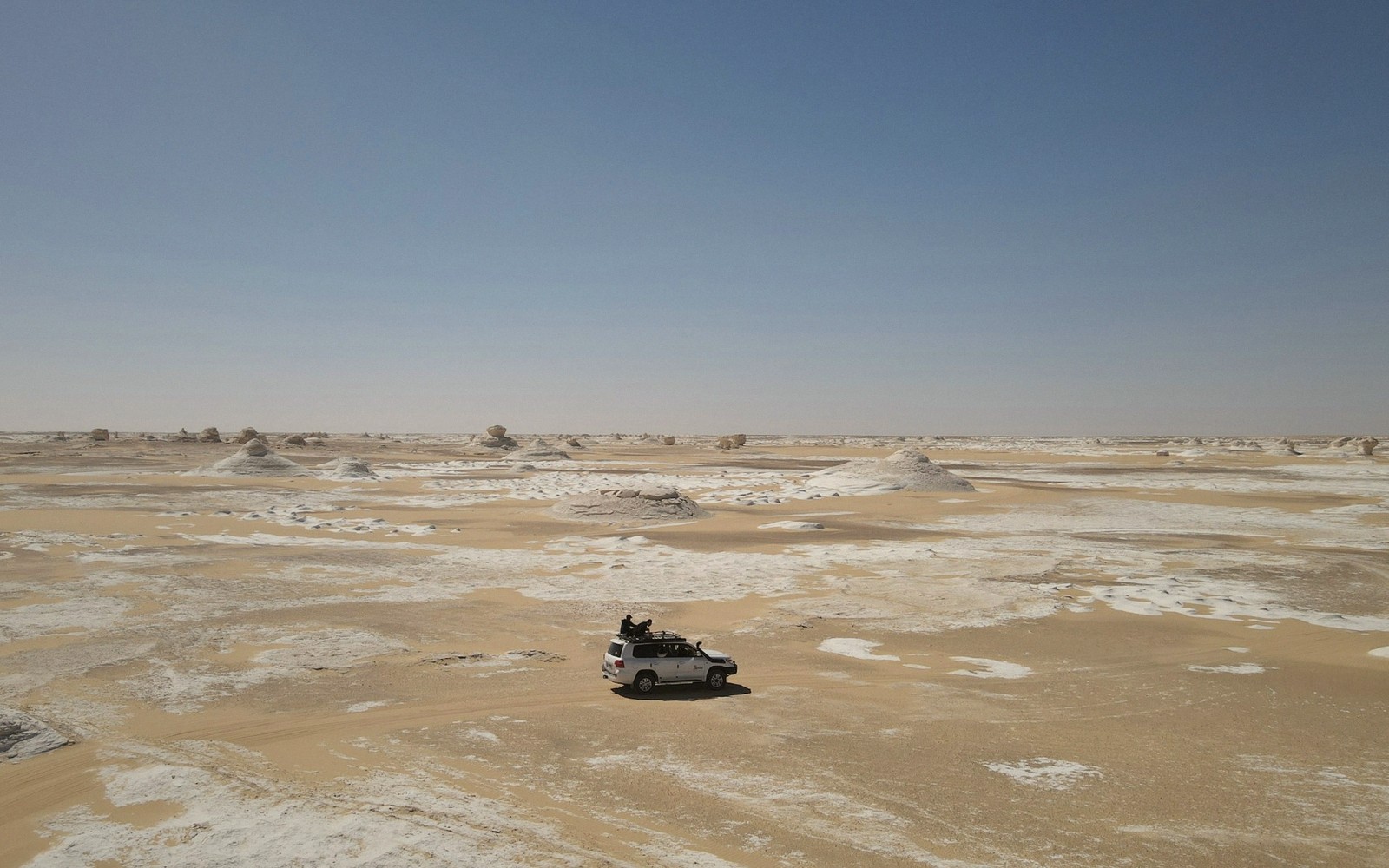
Oases, escarpments and the emptiest ground in Egypt — a vast limestone plateau that rewards preparation and repays the journey.
Egypt's Western Desert is not a metaphor for solitude. It is solitude made geological — a section of the Sahara so vast that it swallows distances casually, offering no reference point except the sky and the occasional dark smear of an escarpment against cream-coloured stone. From the Nile Valley to the Libyan border, the land runs roughly seven hundred kilometres without a river, mostly without a road and, in its deeper reaches, without a footprint. It is the dominant physical fact of the country, occupying more than two-thirds of Egypt's total area, and yet most visitors pass through it at thirty-five thousand feet without a thought.
The desert sits on a thick platform of Eocene limestone, overlaid in places with sandstone, and interrupted by a series of depressions — geological basins worn deep enough to reach the water table — that become the oases. These are not scattered randomly. They follow a rough northwest-to-southeast arc from Siwa, close to the Libyan border, south through the great chain of the New Valley: Bahariya, Farafra, Dakhla and Kharga. Each occupies a different character of landscape, a different history and a different distance from whatever a traveller would call easy access. Together they form the bones of a journey that takes days to do properly and rewards every hour of it.
Between the depressions, the plateau is not simply flat. The Western Desert contains great ergs — seas of drifting sand — and regs, stony plains scoured clean by wind. The White Desert, north of Farafra, is neither: it is a surreal field of chalk formations bleached near-white, sculpted by aeons of wind abrasion into shapes that read simultaneously as organic and alien. Inselbergs of white and cream rock stand clear of the plateau surface in forms that seem to have been placed, not grown. Camping here on a still night, with no artificial light within a hundred kilometres, is one of the genuinely unclassifiable experiences Egypt provides.1
01The Oases in Turn
Bahariya sits around three hundred and sixty kilometres southwest of Cairo along a good asphalt road — the closest of the major oases to the capital, and the most visited for that reason. Its main town, Bawiti, serves as the staging point for excursions into the Black Desert, a volcanic field of dark basaltic powder and dolerite hills to the north, and into the White Desert beyond. Bahariya's own antiquities are modest but genuine: a scattering of New Kingdom and Late Period tombs, some with painted relief work, and a temple built by Apries and later extended under the Ptolemies. The oasis also produced one of the more startling recent discoveries in Egyptian archaeology — a large Graeco-Roman necropolis unearthed from beneath the desert floor in the 1990s, yielding dozens of gilded mummies and earning the immediate nickname the Valley of the Golden Mummies. Excavations are ongoing.
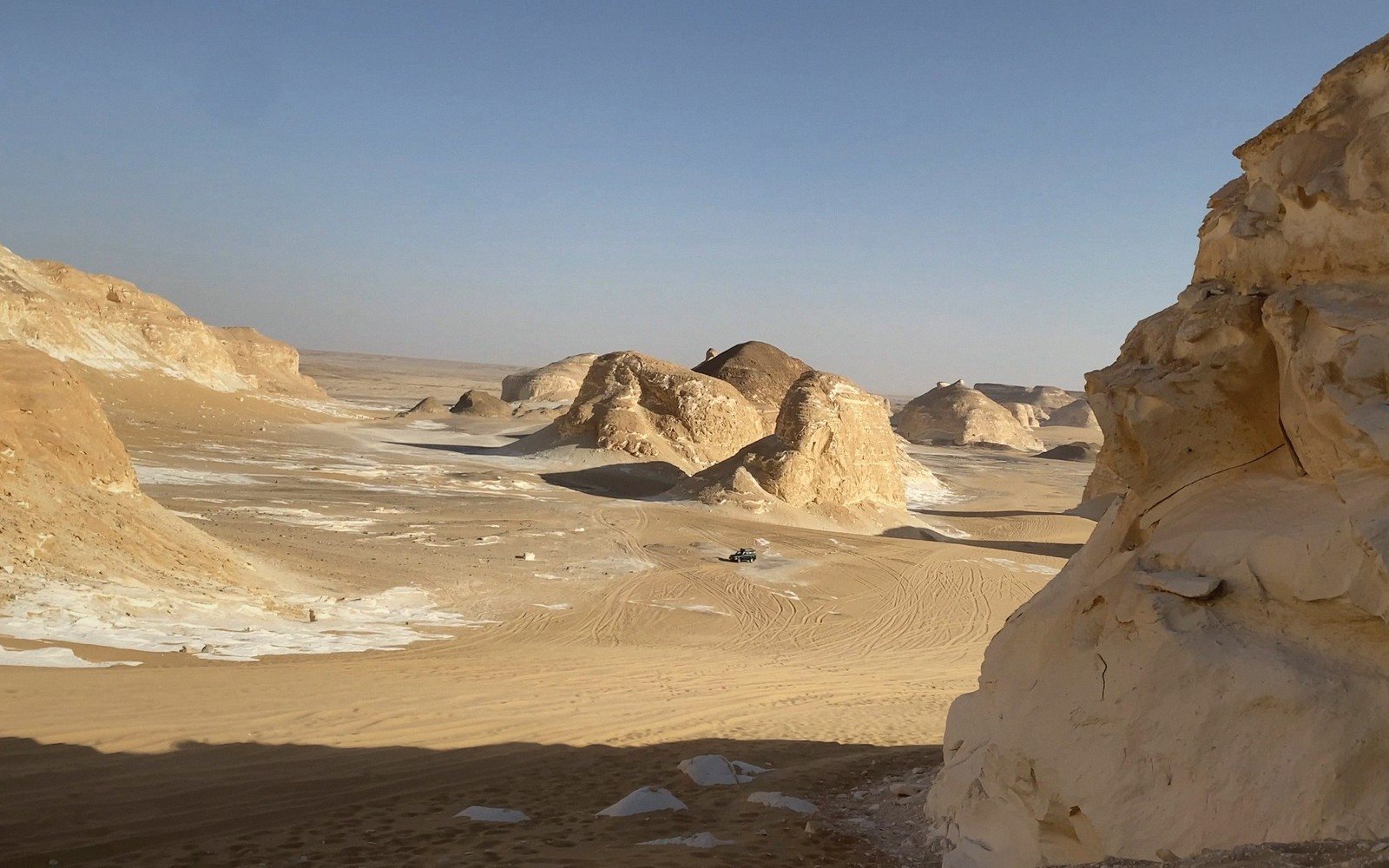
Farafra, the smallest of the chain, has little infrastructure but anchors access to the White Desert. The rock formations are protected within a national park, and the landscape around the oasis itself — date palms, a few springs and a compact mud-brick village — has a stripped-back quality that heavier tourist presence elsewhere has erased.
Dakhla, further south, is a different proposition: a large, inhabited oasis with a medieval mud-brick town at Al-Qasr worth a slow morning's exploration on its own terms. The narrow lanes of Al-Qasr preserve Mamluk-period architecture, including a well-preserved mosque minaret and carved wooden doorways above which the names of former owners remain legible. The ancient layer runs deeper still: the Roman site of Ismant al-Kharab, known in antiquity as Kellis, contains painted Christian tomb chapels dating to the third and fourth centuries — an unexpected footnote on the reach of early Christianity into the most remote corners of the empire. Dakhla's agricultural richness, fed by artesian springs, makes it unusually verdant; arriving here from Farafra, the green is nearly shocking.
Dakhla's agricultural richness, fed by artesian springs, makes it unusually verdant; arriving here from Farafra, the green is nearly shocking.
Kharga, the easternmost of the chain and the closest to the Nile Valley, is the most developed. The provincial capital has grown considerably and carries the self-conscious feel of a town that exists partly by administrative decree. Its antiquities are genuinely significant: the Temple of Hibis, built largely under the Persian-period pharaoh Darius I in the late sixth and early fifth centuries BCE, is one of the best-preserved temples from that era in Egypt, its walls still carrying detailed painted reliefs. Kharga also holds a remarkable Coptic necropolis at Bagawat, where mud-brick funerary chapels dating from the third to the seventh centuries CE are decorated with painted biblical scenes. The juxtaposition of Pharaonic, Persian, Roman and Early Christian layers within a few kilometres of each other encapsulates the depth of the oases' history.
Siwa, isolated at the northwestern edge of the depression zone close to the Libyan border, stands apart from the New Valley chain in almost every respect. Its culture, language and architectural tradition are distinct — the Siwa Oasis supports a Berber-speaking community with its own customs and a built heritage of mud-salt construction quite unlike anything in the Nile Valley. The ruins of the ancient oracle temple of Amun, which drew the Macedonian general Alexander the Great on a famous detour in 331 BCE, sit above the modern town alongside the eroded bulk of the medieval fortress of Shali. The salt lakes surrounding the oasis are shallow, pale green and completely still; viewed from the Dakrur escarpment, they make Siwa look like a mirage that has decided to stay permanent.2
02Practicalities and Orientation
The Western Desert rewards preparation in a way that most of Egypt does not. Petrol, water and mechanical reliability matter here in ways that they simply do not beside the Nile, and the landscape's apparent emptiness is real rather than scenic. Roads between the major oases have improved considerably — the asphalt track along the New Valley spine is driveable in a standard vehicle in dry conditions — but the deeper desert, including the Great Sand Sea that fills much of the region south of Siwa, requires four-wheel drive, local knowledge and a respect for sand that only experience teaches.
The customary approach is to join an organised desert safari or hire a local guide based in Bahariya or Dakhla who knows both the terrain and the supply points. Independent travellers with appropriate vehicles and desert experience can manage certain routes alone, but self-sufficiency must be total and contingencies planned rather than improvised. Night temperatures in winter drop sharply; summer heat in the depression floors can be genuinely dangerous in the middle hours of the day. The best travel season is October to March, when the light is extraordinary and the air cool enough for sustained walking.
Accommodation exists at all the major oases, ranging from simple guesthouses in Farafra to larger hotels in Kharga and Siwa. Standards vary considerably. Bring a detailed map or reliable GPS tracks — signage in the deep desert is minimal and directional landmarks scarce. Mobile network coverage fades reliably beyond the main towns.
What the Western Desert offers, at its plainest, is an experience of Egypt that the Nile Valley cannot provide: the sense of the country's geological age, the exposure of a landscape shaped by wind and time with almost no human interference, and the reminder that the oases and their long populations represent not an accident but a sustained act of human ingenuity in one of the most demanding environments on earth.
Chronology
- Late 6th–early 5th centuries BCETemple of Hibis at Kharga built under Darius I
- 331 BCEAlexander the Great visits the oracle of Amun at Siwa
- 3rd–7th centuries CECoptic funerary chapels built at Bagawat necropolis, Kharga
- 3rd–4th centuries CEpainted Christian tomb chapels at Kellis (Ismant al-Kharab), Dakhla
- 1990sGraeco-Roman gilded mummy necropolis discovered at Bahariya
Named in this guide
Bahariya Oasis
oasis ~360 km southwest of Cairo; gateway to Black and White Deserts
Farafra
small oasis; main access point for the White Desert national park
Dakhla Oasis
large, fertile oasis; includes medieval Al-Qasr and Roman-era Kellis
Kharga Oasis
easternmost major oasis; site of Temple of Hibis and Bagawat necropolis